Gas Price Hike in Chennai: Auto Drivers Struggling
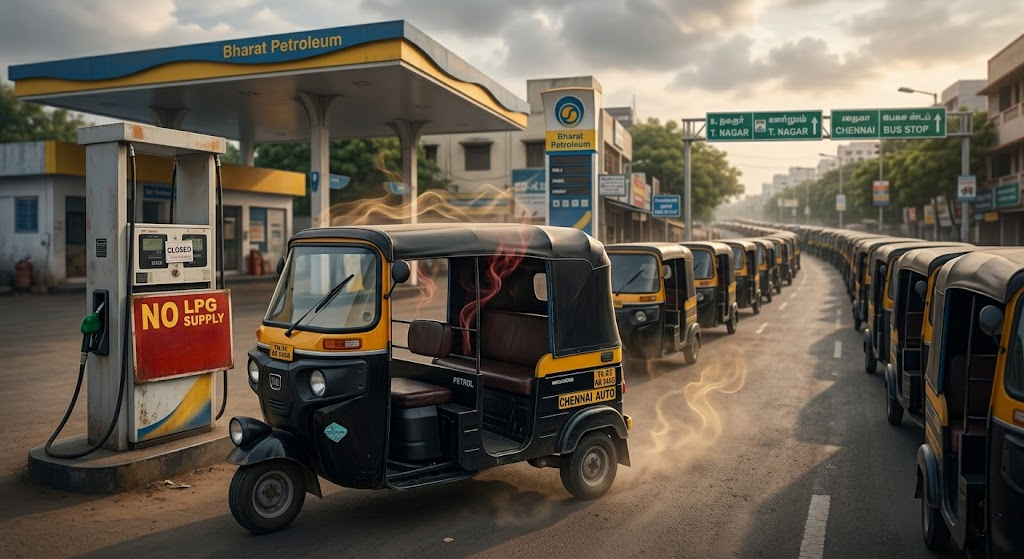
The situation in Chennai has become a bit difficult over the past few days, especially for people who depend on auto-rickshaws for daily travel. Usually, autos are seen as an easy and affordable option for short distances or last-mile connectivity, but right now things are not that smooth. Because of rising fuel prices and shortage, both drivers and passengers are facing problems in their own way.
Talking about LPG first, which is commonly used in many autos, the price has gone up quite a lot. It has reached around ₹84 at many pumps, and in some private places, it is even touching ₹100. This feels like a big jump because not long ago, the price was somewhere near ₹69. Slowly it kept increasing, and now it has reached a point where drivers are finding it hard to manage daily expenses.
Along with the price hike, there is also a shortage problem going on. In the last couple of days, many filling stations either remained closed or did not have enough stock. Even at the places where gas is available, long lines can be seen. Drivers sometimes have to wait for more than an hour just to refill. This waiting time directly affects their work. If a driver loses even 2–3 rides in a day because of this, it makes a difference in their earnings.
For many auto drivers, this is not just a small inconvenience. Their daily life depends on what they earn each day. There are drivers who don’t have a fixed monthly income, so if they are unable to work properly for even a day or two, it becomes difficult to manage household expenses. Things like rent, school fees, and vehicle maintenance are already there, and now fuel cost is adding extra pressure.
Because of this situation, many drivers have started charging a little extra for each ride. Usually, it is around ₹10 to ₹20 more than before. From their side, it makes sense because their cost has increased. But from the passenger’s side, it is not always easy to accept. People who travel daily already have a fixed budget, and even a small increase in fare starts adding up. This is why small arguments between drivers and passengers are becoming more common.
Some passengers feel that drivers are charging more than needed, while drivers feel that they have no other option. The truth is, both sides are dealing with their own problems. Costs are going up, but income is not increasing at the same speed. So it creates a kind of tension where no one is fully satisfied.
Another thing that drivers often mention is that fare rates have not changed for a long time. According to them, the current rates do not match today’s fuel prices and expenses. If fares were updated properly, maybe there would be less need to ask for extra money separately. But right now, things are not balanced, and drivers are trying to adjust in their own way.
On top of all this, there are some extra costs that people usually don’t notice. For example, getting a fitness certificate for the auto officially costs much less, but in reality, drivers often end up paying a much higher amount through different channels. These kinds of expenses keep adding up and make things even harder for them.
If you look at the bigger picture, this kind of situation is not just about one city. Fuel prices are often affected by global factors like supply issues or international tensions. When something changes at that level, the impact slowly reaches local areas too. What is happening now is just one example of that.
Passengers are also not having an easy time. Not everyone has access to convenient public transport for every route, and autos play a big role in daily travel. When fares increase, even slightly, it affects students, office workers, and small business owners who depend on regular commuting.
If this situation continues for some more time, there might be more changes ahead. Some drivers may look for alternative options, or some people might try to reduce their usage of autos. But as of now, both drivers and passengers are just trying to manage somehow.
In simple terms, it’s like a chain reaction. Fuel prices go up, driver costs increase, fares go up, and then passengers feel the burden. Until things settle down, this cycle may continue for a while.